Metal Siding: Steel & Aluminum Costs, Styles & Care
Compare steel and aluminum systems.
Check site suitability and care guidance.
Ask how panels and finishes are repaired.
Metal siding is a broad category that includes steel and aluminum products, multiple profiles and different coating systems. It can create anything from a traditional lap-sided exterior to a vertical contemporary facade. The useful comparison is between named products and complete installation scopes, rather than between two generic “metal siding” prices.
This guide explains metal siding costs, appearance, finish care and questions about exposure and repairs. For project-wide budgeting and wall measurement, read our siding installation cost guide.
Plan your project & request siding quotes ↓
Metal siding costs: steel and aluminum
HomeGuide publishes installed planning ranges of $7–$16 per square foot for steel and $6–$10 for aluminum. Its source article is dated August 2023, so these are older published benchmarks reviewed for this guide, not a current local price survey. Obtain fresh contractor quotes before setting your budget.
| Material | Published installed benchmark | Illustration for 1,000 sq. ft. of cladding |
|---|---|---|
| Steel | $7–$16/sq. ft. | $7,000–$16,000 |
| Aluminum | $6–$10/sq. ft. | $6,000–$10,000 |
The arithmetic examples use exterior siding area. They do not establish the siding quantity for a 1,000-square-foot home. Profile, gauge, coating, trim, removal and access can alter the project scope, and different published cost guides use different assumptions.
Ask for the base metal, manufacturer, product line, profile, gauge or thickness specification, coating and accessories. Compare those details alongside the installed total.
Check which preparation and repair items are included before adding the published rate to your budget. Ask for separate allowances for unknown wall repairs and a written approval process for extra work. Do not assume an installed benchmark includes a redesign of the existing wall assembly.
Record the gauge, finish, accessories and exposure guidance.
Record thickness, finish, accessories and repair guidance.
Steel, aluminum and the finish system
Start by identifying the base metal. Steel and aluminum should not be treated as the same product with different price tags. Then ask the manufacturer or installer which finish and accessory system is proposed for your house and whether it is suitable for the site’s exposure.
| Specification | What to ask |
|---|---|
| Base metal | Is the product steel or aluminum? |
| Thickness | What gauge or thickness is supplied for this exact product? |
| Coating | What finish, color and warranty apply? |
| Accessories | Which corners, flashings, trim and fasteners are specified? |
| Exposure | Is the product approved for the site’s climate and conditions? |
| Repair | How would damage to a panel or coating be addressed? |
A gauge number alone is not a whole performance specification. Profile geometry, the finish and the approved installation also matter. Ask for product literature and physical samples rather than drawing a conclusion from a salesperson’s claim that one board is “heavy duty.”
For coastal, industrial or other demanding exposures, obtain product-specific guidance. Do not assume that a general statement about the base metal settles the suitability of the complete system. Ask how the selected coating, accessories and fasteners are addressed in the warranty.
Look closely at a metal-siding surface
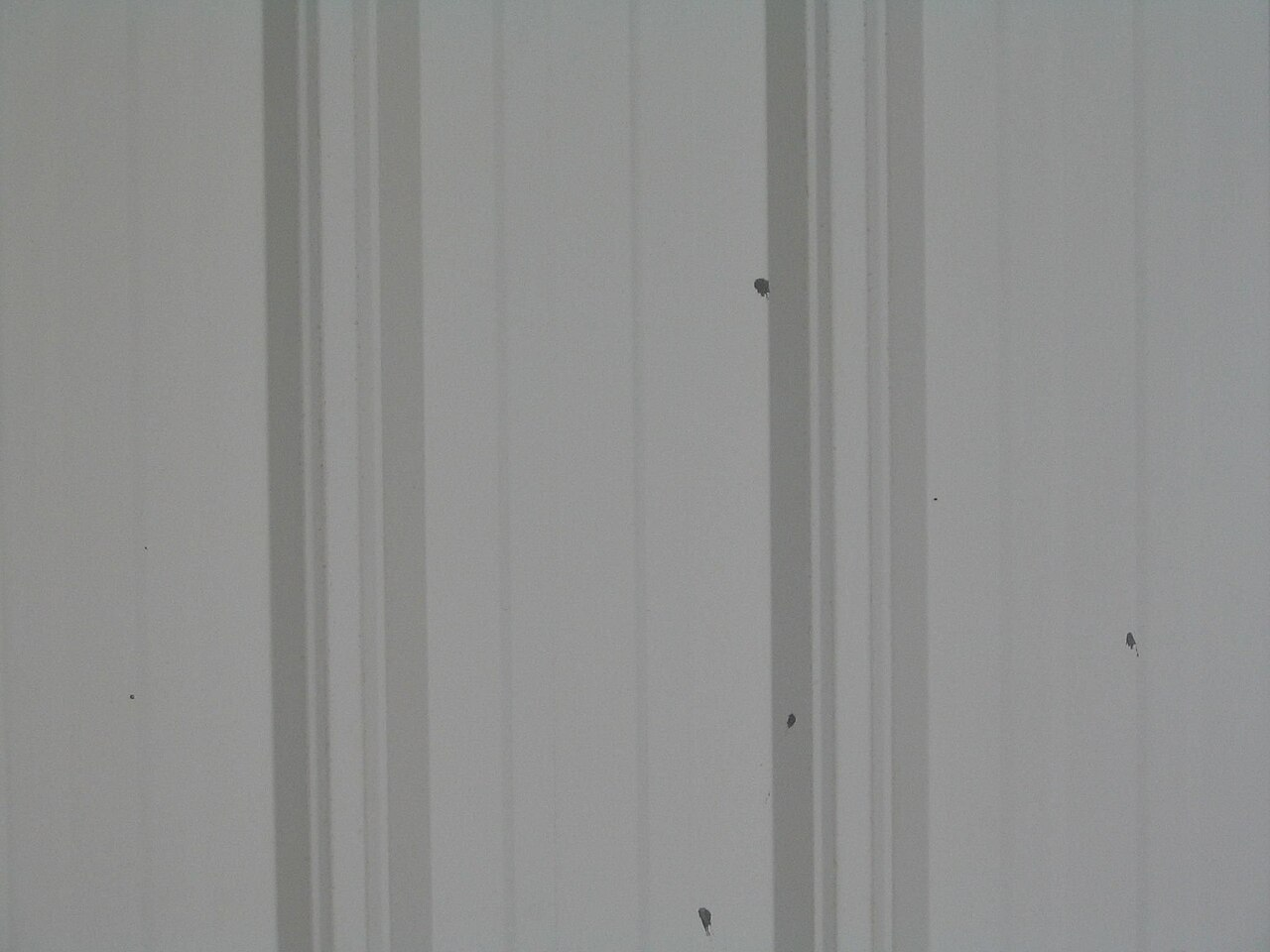
Use photographs to compare appearance, then review a physical sample of the product you are considering. Select a photo for a larger view without leaving this guide.
 View larger photo ↗
A photographed metal-siding surface. Compare its ribs, shadows and finish. The alloy, coating and manufacturer are not specified.
Photo: Titus Tscharntke / Wikimedia Commons · Public domain. Displayed in a cropped frame; larger view shows the full photograph.These are independently sourced examples, not projects completed by Siding Cost Guide or an endorsement of a particular installer. Material identification follows the source description.
Confirm seam appearance, trim and the exact product.
Confirm visible fasteners and approved orientation.
Profiles, seams and the look of your home
Metal siding is not limited to corrugated sheets. Product lines may offer horizontal lap, vertical board-and-batten looks or other panel patterns. For example, EDCO offers a steel board-and-batten siding product; other manufacturers use different shapes and joint details.
Review a layout drawing that shows the board direction, seams, corners and window trim. Ask whether fasteners are visible in the chosen system. Also look at how the profile terminates at the roofline and base of the wall; those details influence the appearance as much as the field color.
Choose the design at house scale. A deep vertical profile can be a useful accent on a gable or entry, while repeating several patterns may make a small elevation feel crowded. Request alternate pricing for an accent area if you are comparing it with a single-profile exterior.
Inspect a real sample outdoors. Ask to see a completed installation of the same product when possible, and view it from both close range and the street. Product renderings do not reveal every seam, shadow or trim proportion you will notice on your own house.
Installation and exposure questions
Metal cladding is part of the wall assembly. Ask the contractor to explain preparation, the water-management approach and transitions around openings. Installation must follow the selected manufacturer’s requirements and applicable local code, not a generic method for every metal panel.
- Will the existing siding be removed and the underlying wall inspected?
- How will window, door and roof-to-wall flashing be handled?
- Which fasteners and accessories are specified for this product?
- How are cutting, handling and coating damage addressed?
- How does the system accommodate the manufacturer’s movement requirements?
- Who handles permits, inspections and any related trade work?
Ask about wind-design suitability for your location using the actual product and assembly documentation. A broad claim that “metal handles storms” is not a substitute for evidence about the system proposed for your house.
Also clarify what happens if a delivery is damaged or replacement material is needed. Agree who inspects material before installation and how substitutions are approved. Having these decisions in writing can prevent a later disagreement about dents, scratches or a different trim finish.
Coating care, dents and repair
Follow the manufacturer’s cleaning instructions for the installed coating. EDCO’s care guidance describes gentle cleaning methods, including soft brushes and low pressure. Other finishes may have different requirements; do not assume aggressive pressure washing or strong cleaners are acceptable.
Ask what to do after a scratch, impact or persistent stain. A repair might involve a manufacturer-approved touch-up process or replacement of the affected panel. The correct response depends on the product and damage, so get guidance before applying an improvised coating.
Consider impact exposure during planning. Areas beside driveways, play spaces or equipment storage may need special attention when choosing a profile and discussing repairs. Ask how a damaged panel is removed and whether adjacent trim or panels must be disturbed.
Keep the product name, color code, installer invoice and any specified touch-up information. A future replacement may not be an exact visual match after the existing exterior has aged. Ask whether keeping spare material is useful for this particular system and how it should be stored.
Repainting and warranty questions
Do not assume that every metal siding finish can be repainted without affecting coverage. EDCO’s own FAQ states that repainting its steel siding voids the product warranty. That is a product-specific condition, not a rule for every metal siding brand.
Read the terms for your proposed product before choosing it. Ask whether coverage applies to the metal, coating and labor, and whether fading, chalking or other finish changes have separate provisions. Check exclusions, transfer rules and the process for reporting a problem.
If you are buying a house with existing metal siding, identify the product before planning a color change. Compare professional cleaning, coating assessment, approved repainting where available and replacement as separate scopes. “It can be painted” does not answer the warranty or preparation questions.
Also request a workmanship warranty from the installer. Keep it separate from the manufacturer’s paperwork so you know whom to contact about an installation issue and which costs are included.
How metal compares with other materials
Review vinyl siding for another factory-color option, or fiber cement and engineered wood for other lap and panel choices. Compare the same wall area, design and trim scope.
For a mixed exterior, ask who coordinates the transition between materials. A metal accent may change the accessories and layout even when it covers a small area. Price the complete transition rather than simply multiplying the accent area by a generic rate.
Make the final choice using appearance, exposure suitability, care guidance and the clarity of the repair plan. An installer who can explain a specific product and its details gives you a stronger basis for comparison than a broad durability promise.
Plan your siding project
Bring a clear brief to your first contractor conversation.
Your home, your material choices, your scope.
- 01Describe the work
Installation or repair? List the walls, visible issues and photos to discuss.
- 02Choose your starting options
Note preferred materials, profiles and finishes. Ask about suitable alternatives.
- 03Compare a complete scope
Check removal, wall preparation, trim, repairs and warranty coverage.
Tell us about your installation or repair project using the quote request form. Contractor availability depends on your location and scope.
Common metal siding questions
Will it be noisy in the rain?
A siding-only material label does not establish interior noise. Ask about the complete wall assembly and, where possible, experience a comparable installation. Do not apply claims about metal roofing automatically to wall cladding.
Is all metal siding maintenance-free?
No. Check cleaning, coating inspection and repair guidance for the selected product. A factory finish still has care requirements and warranty conditions.
Can one damaged panel be replaced?
Ask the installer to explain the repair sequence for your exact profile, including surrounding trim and color matching. Accessibility and product availability affect the answer.
Sources and cost methodology
View sources and pricing methodology
Cost benchmark: HomeGuide metal siding cost guide (dated August 1, 2023; reviewed October 1, 2026). Product-specific references: EDCO steel board-and-batten siding, EDCO care guidance and EDCO FAQ. EDCO’s statements describe its own products, not every metal siding system.
Published national ranges are planning benchmarks, not a survey of today’s local bids. Our area examples are simple multiplication, not project estimates. Labor, product availability, access and concealed repairs can change the final price. Technical requirements depend on the selected system, manufacturer instructions and local code.